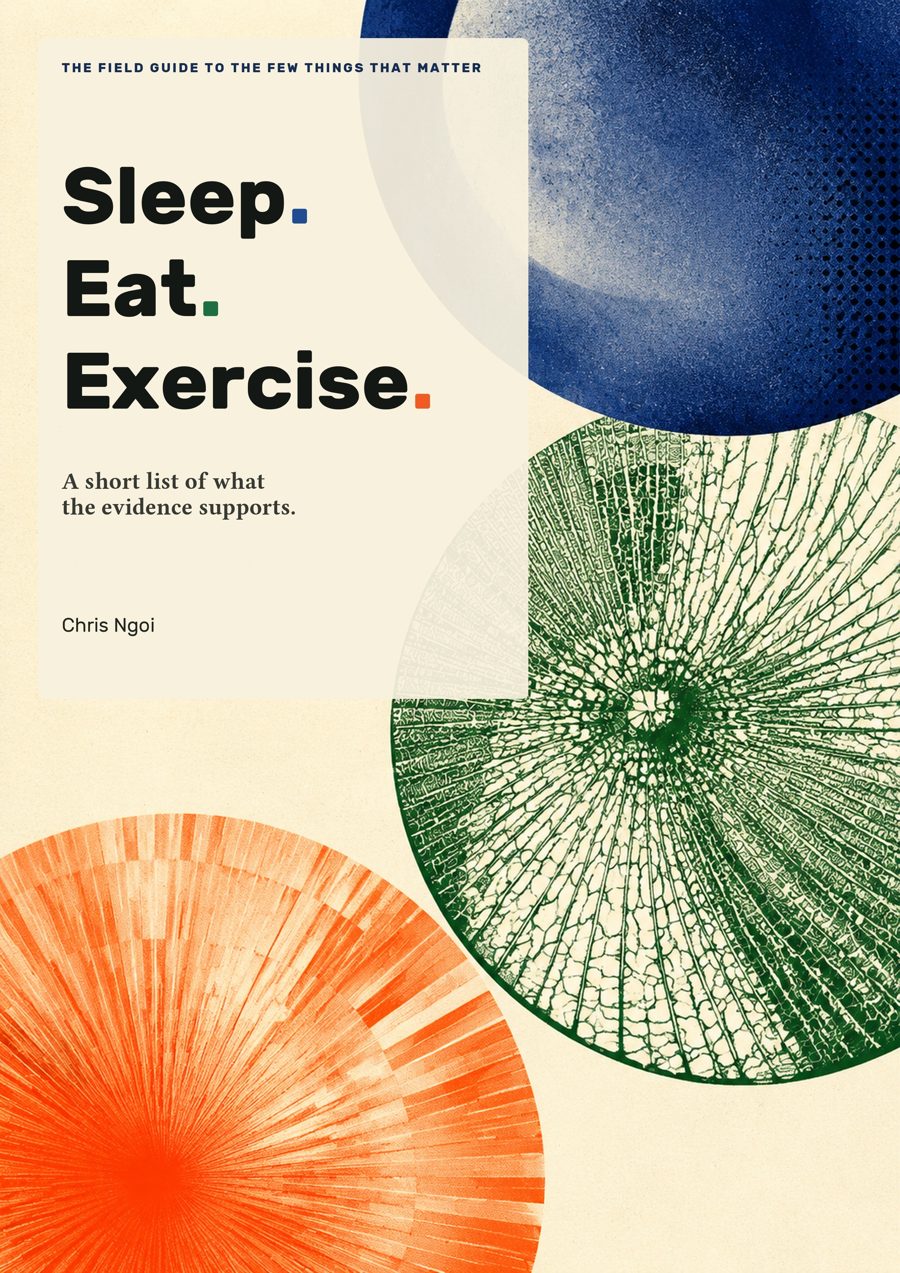
Sleep. Eat. Exercise.
A short list of what the evidence supports
You do not have time to read a book about your health. This is a short one: about 160 pages on sleep, food and training, what you are usually told set against what the studies show, almost every claim traced to its study and the study graded, with the gaps marked. Where a claim has no source behind it, the book says so on the page.
Five promises this book keeps
Nothing you have to buy, nothing to chase, nothing to be perfect at
- No miracle supplement
- No glucose panic
- No anti-aging pill
- No 30-day fix
- No perfection required
Who this is for: people with no time, who kept asking the same handful of things. What is the real stuff in all the noise? Where should they start? What can they trust?
The book’s answers turned out to be dull: get enough sleep at a regular time, eat enough protein, lift something twice a week, walk more than you do.
The rest of the book is the evidence behind those four lines, what to do when your week does not cooperate, and the signs that belong in front of a professional.
Do not, by default. This one asks to be checked instead
Almost every claim that rests on evidence is traced to its source and carries a grade for that source, printed beside the entry in the source list. Familiar advice and prescribing cautions carry none. The whole source list is public on this site: each source with its grade, the book’s own sentence that rests on it where the page names it in prose (and the Sources line where that is the only mention), and its full citation, with a DOI or PMID wherever one is issued, so you can go and read the paper yourself.
Before publication, more than thirty researchers and clinicians were asked whether the research is cited fairly. Twenty-two of them read the pages that concern them and are thanked by name in the book, beside the author of the foreword. Being thanked says who checked a line, and endorses nothing; the acknowledgments page says so. Where they found the book wrong, it changed, and the corrections that arrive after publication will be public too.
- 160pages
- 134on the four-step scale, Strong to Emerging
- 4grades, plus two labels
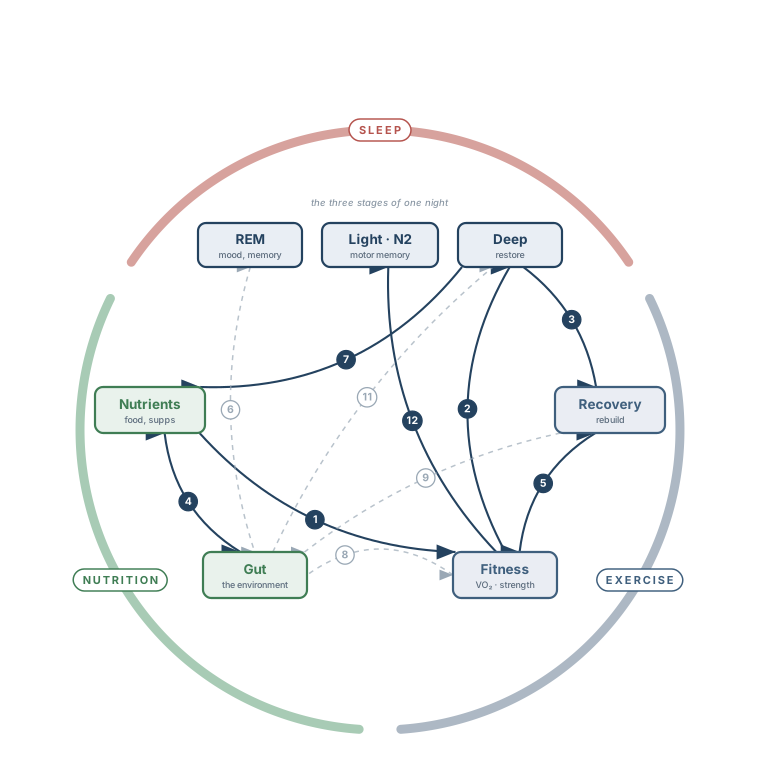
- 12mapped pathways
| Grade | What earns it, and the common misreading |
|---|---|
| Strong | Pooled randomized trials, or replication across many laboratories, large enough to settle the direction. That Strong means settled for good. Even these get overturned, just less often. |
| Established | At least one well-conducted randomized trial, or a direction no longer in dispute. It says how confident I am, and nothing about the size of the effect. |
| Moderate | Prospective cohorts, or several small or short trials. Most useful lifestyle evidence sits here. Not a tier to skip. |
| Emerging | Mechanistic, cross-sectional or animal work, or one small trial on its own. Dashed on the map. Limited confidence for the stated claim; the evidence may include human studies, and the limitation is in the entry. |
| Background | Reading that informs the argument without being a study. No grade. A claim resting on it is marked as such. |
| Guidance | A clinical body, a regulator or a formulary sets the rule. The entry names which. A kind of source rather than a rung; I have not re-graded what sits behind it. |
Three pillars, one system
The book treats sleep, food and training as one loop rather than three separate lists. Twelve pathways connect them, and the map says how well each one is evidenced. Then it puts the loop under stress.
-
Sleep. Where to start
A fixed wake time, morning light, caffeine and alcohol timing, and what each stage of the night does. Pages 23 to 42.
-
Eat. The fuel
Protein and plants, the six nutrition decisions that matter, and the gut as something you feed rather than test. Pages 43 to 60.
-
Exercise. The engine
Strength, an easy aerobic base, a little hard work, balance, and where recovery happens. Pages 61 to 78.
Twelve situations where the loop breaks, each with one thing to do this week and a place to write your own. The people in them are invented.
- The 2am racing mind
- The crunch week
- The 3pm crash
- The reset
- Red-eyes, nights and time zones
- The dinner circuit
- Should I take X?
- Burnout
- The annual check
- The clock is not yours
- Staying independent
- The new-parent crunch
Then the back matter: what the book does not try to solve, when to get it looked at (thresholds sourced to WHO, NICE and the AASM), where you differ by sex and life stage, a glossary and index, and the sources, graded.
Who wrote this, and the conflict to know about
I am Chris Ngoi. I am not a doctor and I am not a researcher. The book is my best-effort reading of the reviews, guidance and primary studies I could find, to help people like me navigate how to sleep, eat and exercise better.
I am in the wellness industry, and you should not have to take my word for what that means: my work there includes sleep supplements, and overlaps directly with the supplement pages in this book.
The book recommends no brand or company, and sells nothing. Where a real name appears, it is a source being cited or a method being compared. The support chapter opens by trying to talk you out of most of what is in it, and wherever a free basic does the job, the book says to do that instead. Read all of it knowing where I sit.
If a grade looks generous to you, let me know and I will look into it.
Corrections are public
Some of what is in the book will not survive. Studies conflict, good ones get overturned by better ones, and a finding that looks solid at one sample size can shrink or vanish at a larger one. When a reader or a cited author shows me a line is wrong about the evidence, the correction goes on the corrections page with the date, and into the next printing. Write to review@sleepeatexercisebook.com.
This is information, not medical advice
Nothing in the book or on this site was written about you, because I do not know your history, your medicines or your conditions. It is not a substitute for a doctor, a pharmacist or a nurse, and reading it does not put you in anyone’s care.
Do not start, stop or change a medicine because of anything here. Where the book says something needs adjusting, that is a question to put to whoever prescribes for you. If anything here contradicts what your own clinician has told you, they are right and the book is wrong.
Do not delay care because of anything you read. If something worries you, get it looked at. Thresholds, doses, what is available on prescription and what you are obliged to report all differ by country, so use the figure that applies where you live. The book is written for adults, and the disclaimer that governs every page is on page 5.